
Timber construction, sustainability and bioconstruction
Asturias, Gijón
Building well today means thinking beyond the project itself. It means choosing materials that respect the planet, construction systems that improve comfort, and solutions that endure. Bioconstruction and timber construction are not passing trends: they are a more honest and coherent way of practising architecture.
At AGHO Arquitectura, sustainability sits at the heart of every project. Not as a label, but as a genuine design criterion that translates into concrete decisions: what is built, with what materials, and how.
A sector that needs to change course
Construction is one of the most polluting sectors on the planet. According to the International Energy Agency, buildings account for around 40% of global energy consumption and approximately 30% of global CO₂ emissions. On top of that, there is the environmental impact of extracting and manufacturing conventional materials — cement, steel, plastics — which generate enormous quantities of waste and emissions before they even reach the building site.
This is not a new reality, but for decades the sector has turned its back on solutions that have existed for centuries. Bioconstruction and timber construction are not recent inventions: they are the recovery and modernisation of a way of building that is more in harmony with the environment, now adapted to contemporary technical standards and comfort requirements.
At AGHO Arquitectura, we believe that as architecture professionals we have a direct responsibility in this shift. That is why sustainability is not a marketing argument for us, but a project criterion that is applied from the very first design decision.
What is bioconstruction?
Bioconstruction is an approach that prioritises the use of natural, recycled or low-environmental-impact materials, taking into account the full life cycle of both materials and buildings. Its aim is to create spaces that are healthier for people and less harmful to the environment.
In practical terms, this means timber construction, natural mortar finishes, plant or mineral-based insulation, paints free from volatile organic compounds, and passive climate control systems that reduce dependence on conventional energy sources.
Timber construction: lightweight, strong and sustainable
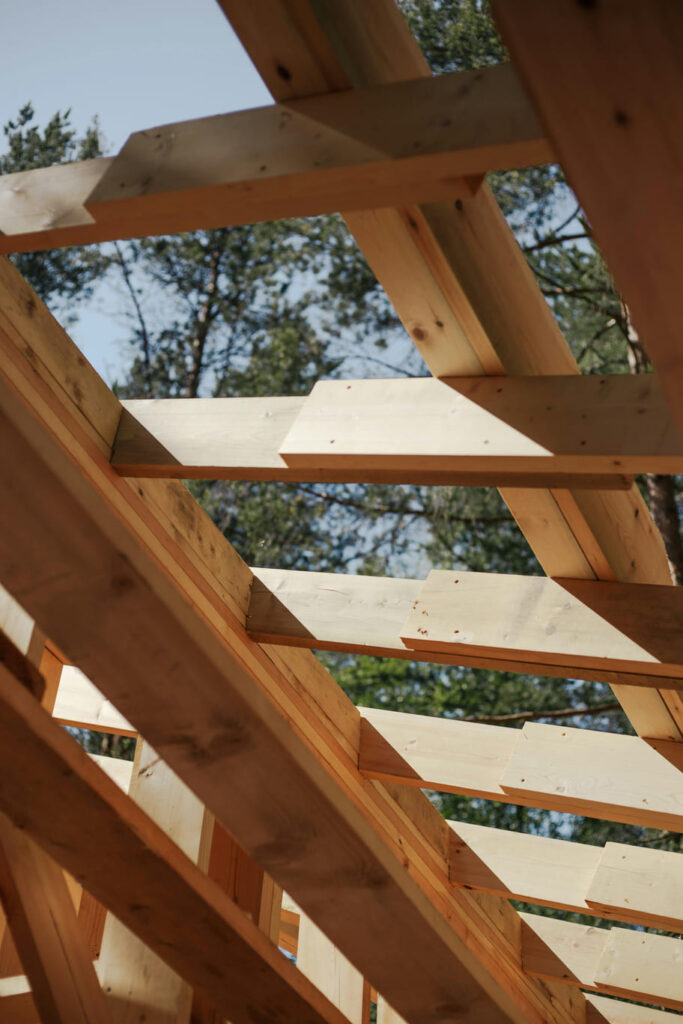
Timber is the only renewable building material. It regulates ambient humidity, brings warmth to spaces, has a negative carbon footprint when it comes from sustainably managed forests, and offers excellent structural performance.
We work with the main timber construction systems, adapted to each scale and programme:
- Light timber frame: an agile and versatile system, ideal for single-family homes and extensions.
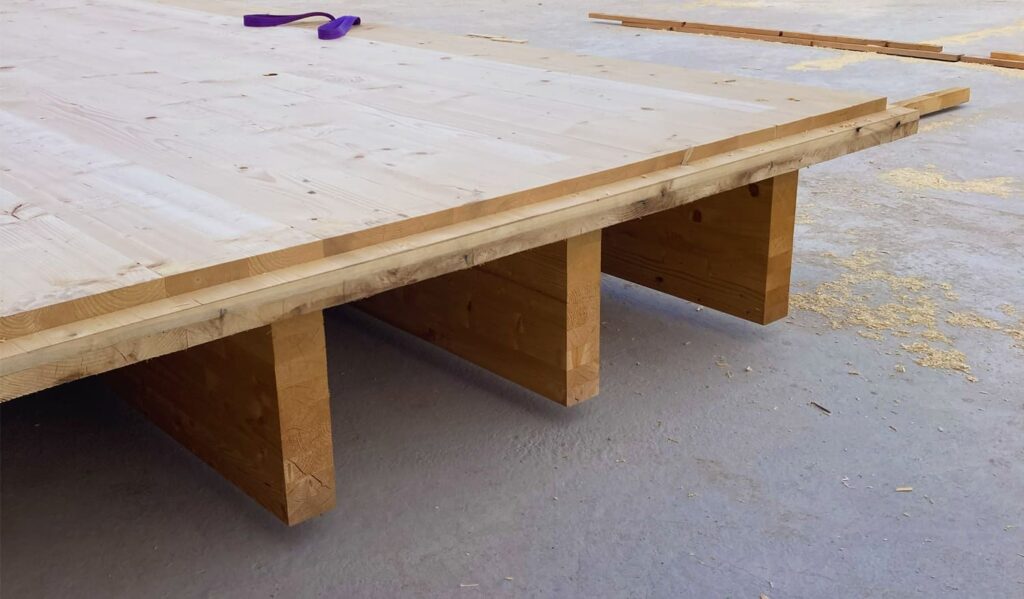
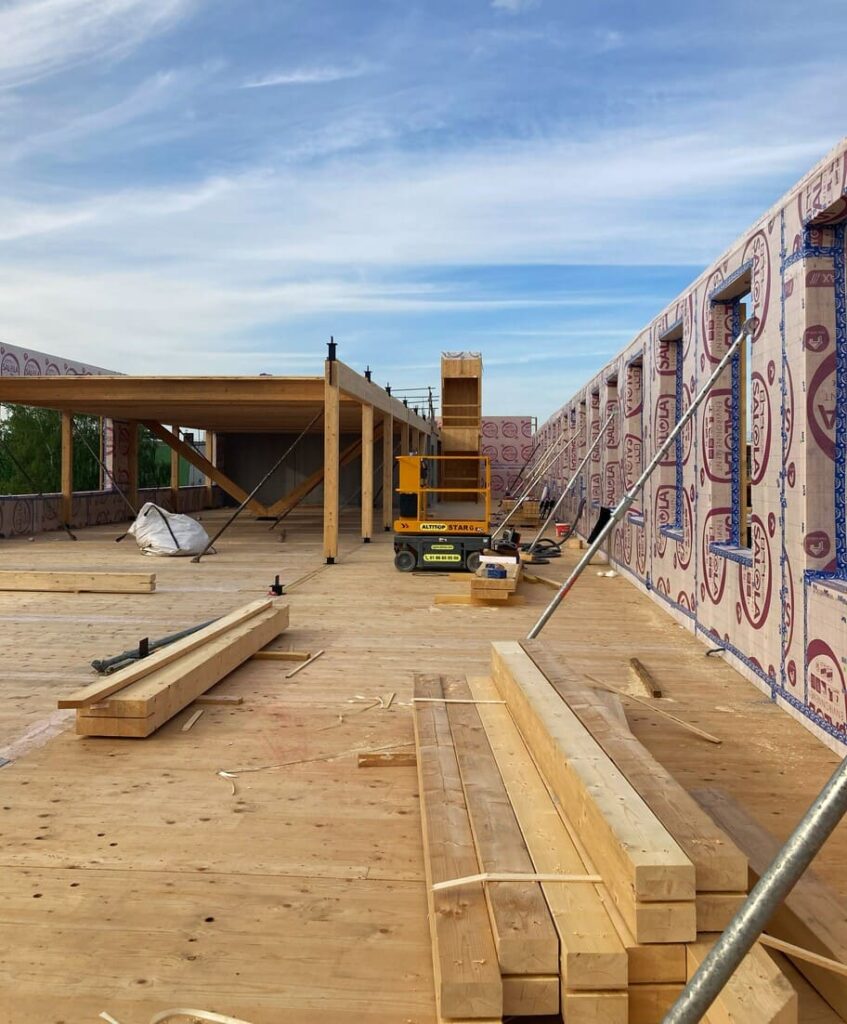
- CLT (cross-laminated timber): high-strength structural panels suitable for multi-storey buildings.
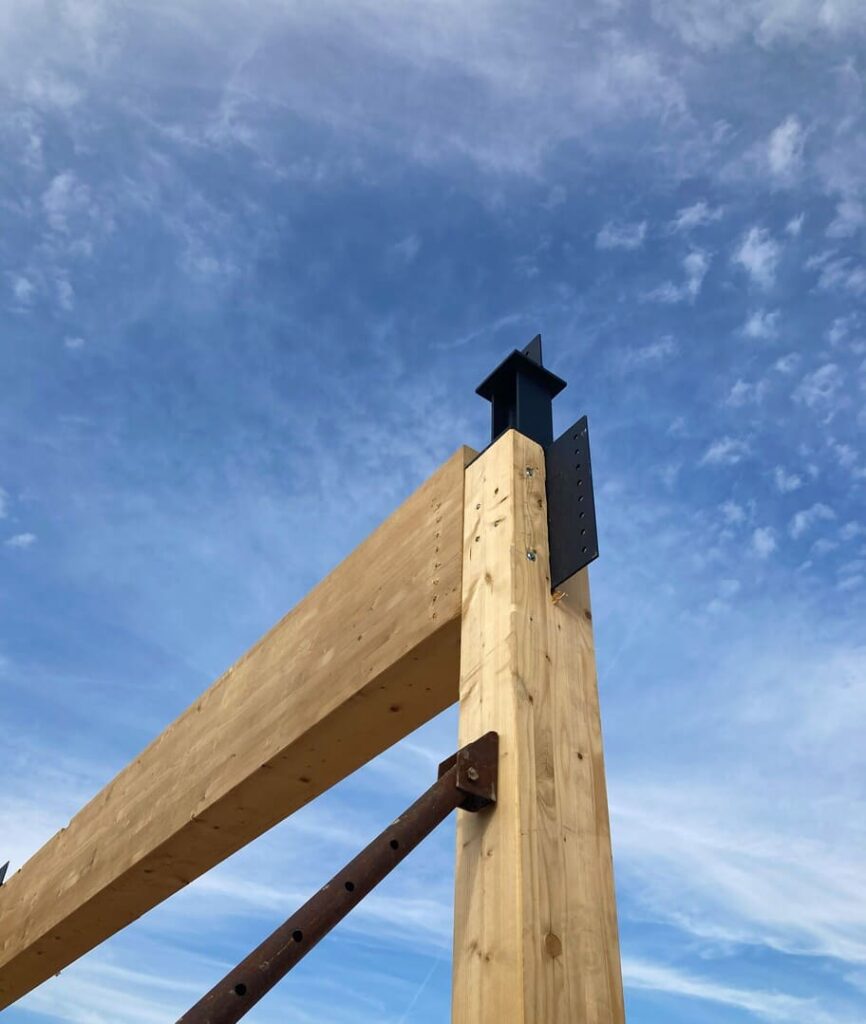
- Hybrid timber-steel structure: combines the advantages of both materials in more complex projects.
We also incorporate timber as an interior design and finishing element, as in Apartment AG in Gijón, where a central cube of okumé plywood organises the entire layout of the space.
Timber in interiors: warmth, comfort and character
Beyond its structural role, timber has a quality that no other material can replicate: it transforms the character of a space immediately. It brings visual and tactile warmth, creates inviting atmospheres and adds a natural texture that industrial materials cannot reproduce. It is no coincidence that in projects where we incorporate timber, it is consistently the element that clients value and remember most.
Timber also naturally regulates ambient humidity, contributes to acoustic insulation and has hygrothermal properties that improve the comfort of a space without the need for active systems. It is a living material that ages well and, with minimal maintenance, improves over time rather than deteriorating.
We incorporate it in floors, wall cladding, ceilings, fitted furniture, joinery and bespoke design elements, always selecting the species and treatment best suited to each application and to the climatic conditions of the project.
Natural and recycled materials
Beyond timber, we favour material palettes that are coherent with the philosophy of each project: natural stone, microcement, metals such as steel, cork or natural fibre insulation. We select materials not only for their aesthetic qualities, but for their long-term performance, ease of maintenance and environmental impact.
Passive architecture and integrated energy efficiency
Sustainability begins at the design stage. Orientation, compactness, thermal mass, solar shading, natural ventilation: these are project decisions that reduce the building’s energy demand before any active system is required. At AGHO, we integrate these criteria from the earliest design phases.
Our experience at Tectoniques Architectes & Ingénieurs (Lyon) — a European benchmark in bioconstruction and low-impact public buildings — has given us a solid foundation for applying these strategies rigorously and effectively in each project.
Sustainability in renovation and refurbishment projects
Sustainable construction is not only for new builds. In renovation and refurbishment projects it is equally possible — and highly advisable — to incorporate bioconstruction principles: improving insulation with natural materials, replacing finishes with healthier alternatives, or upgrading the building envelope to improve energy efficiency.
Frequently asked questions about sustainable construction and bioconstruction in Asturias
Is timber construction more expensive than conventional construction?
Not necessarily. The cost can be comparable to conventional concrete or masonry construction, or even lower in some systems, thanks to faster execution and reduced waste on site. In the long run, the advantages in comfort and energy efficiency generally more than offset any initial difference.
Is timber a durable material for building in Asturias, given the wet climate?
Yes, provided it is correctly specified and the envelope is well designed. Asturias has a long tradition of timber architecture, and modern construction systems — with appropriate treatments, ventilated cavities and moisture protection — guarantee excellent durability. Problems tend to arise from poor workmanship, not from the material itself.
What are the benefits of living in a home built with bioconstruction principles?
Spaces built with natural materials generally have better indoor air quality, greater thermal and hygrothermal stability, and fewer damp and condensation problems. In terms of energy use, they typically consume significantly less than a conventional building. And natural materials age better and create warmer, more inviting environments.
Can you incorporate sustainability criteria in a renovation, not just in new build?
Absolutely. In many renovation projects it is possible to improve insulation with natural materials, replace finishes with healthier alternatives or incorporate controlled ventilation systems. We assess each case to identify which improvements will have the greatest impact within the available budget.
What is CLT and what types of project is it suitable for?
CLT (Cross Laminated Timber) is a structural panel made up of crossed layers of glued boards. It offers excellent rigidity and strength, and is suitable for single-family homes, multi-storey residential buildings and even public facilities. It is fast and clean to install and allows a high degree of prefabrication.